What to Know Before You Decide
A zip screen is a retractable outdoor screen whose fabric has a zipper bead along both side edges. As the screen lowers, those edges run inside an aluminium track on each side of the opening, so the fabric is held on all four sides: the housing at the top, the weighted bar at the bottom and the zipper tracks at the sides. The result is a screen with no side gaps that stays flat in the wind instead of billowing.
Every motorized privacy screen we install in Toronto and the GTA is a zip-track screen. We use Talius Habitat screens with a Somfy motor, so the zipper track is standard rather than an upgrade. This guide explains how zip screens work, how they compare with cable-guided screens and outdoor curtains, and what to check before you buy.
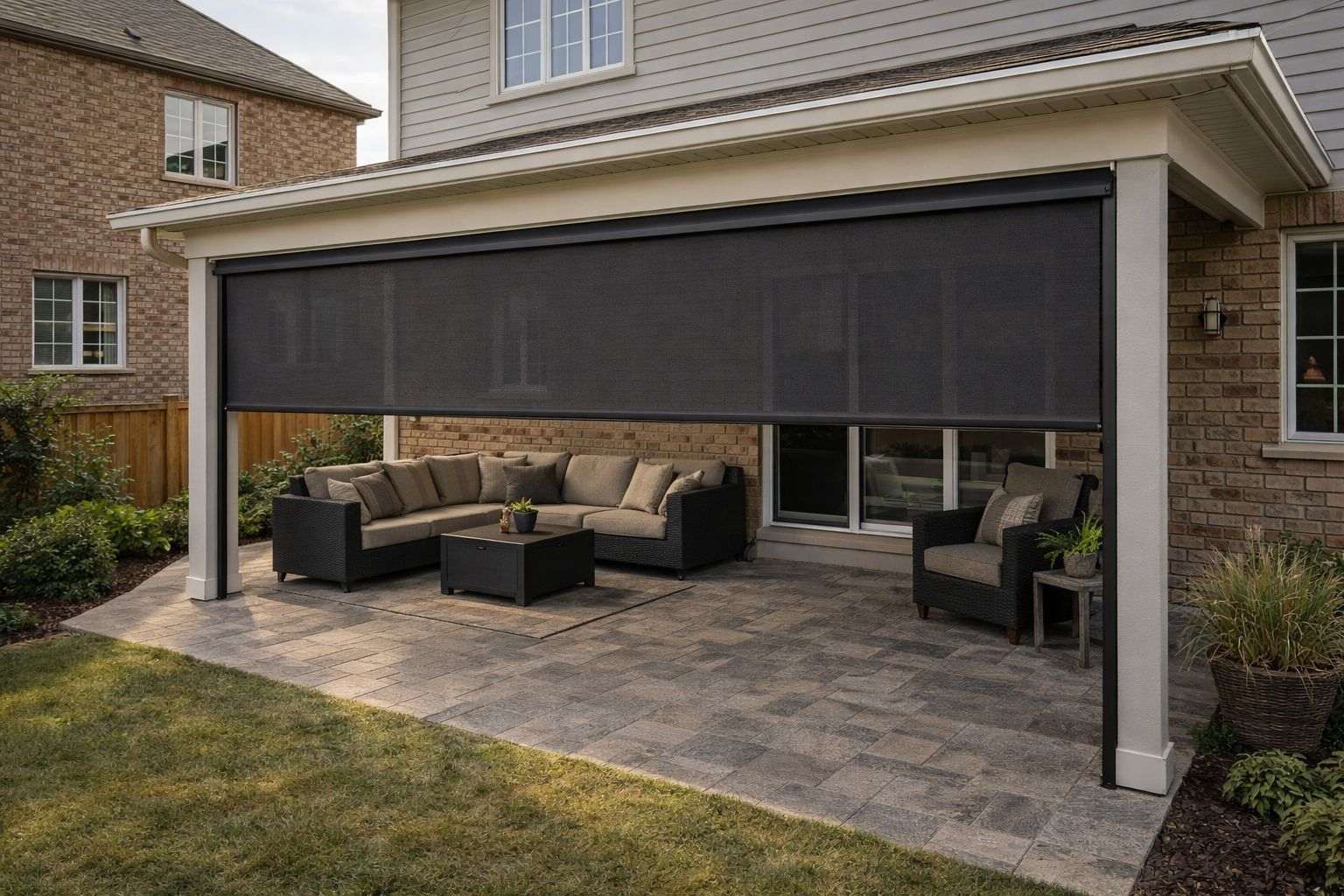
How a zip screen works
A zipper bead is welded or sewn along both vertical edges of the fabric. When the motor lowers the screen, the beads feed into a retention channel inside each side track. The track holds the bead the whole way down, so the fabric cannot pull out sideways or flap at the edges.
Because the fabric is held under tension on all four sides, the screen behaves like a panel rather than a curtain. That is what gives a zip screen its three main advantages: privacy right to the edge of the opening, far better wind performance, and no side gaps for insects to get through.
Zip screens vs. cable-guided screens vs. outdoor curtains
Most outdoor screens fall into one of three groups. The difference comes down to what holds the fabric at the sides.
| Zip-track screen | Cable-guided screen | Outdoor curtain | |
|---|---|---|---|
| Side edges | Zipped into an aluminium track | Loose, guided by a steel cable | Loose, hung from a rod or track |
| Side gaps | None | Small gap along each edge | Open |
| Wind | Stays flat; high wind rating | Moves and can bow in gusts | Billows; must be tied back |
| Insects | Sealed with an insect-rated mesh | Gaps let bugs through | No protection |
| Privacy | Full, edge to edge | Good, with edge gaps | Varies |
| Operation | Motorized, remote or app | Manual or motorized | By hand |
| Looks when up | Hidden in a slim housing | Hidden in a housing | Fabric stays visible |
What "electric", "invisible track" and "privacy protection" mean in product listings
- Electric or motorized zip screen: the roller is driven by a tubular motor inside the housing. Ours use Somfy motors with a remote, a wall switch or a phone app, and can be grouped so several screens move together.
- Invisible track: a marketing term for a zipper channel that hides the fabric edge, so you see a clean line rather than a cable or loose hem. The track itself is a slim aluminium profile, finished to match the housing.
- Privacy protection zip screen: a zip screen fitted with a dense privacy fabric. How much it hides depends on the fabric openness, not the track. See how to choose a privacy screen fabric.
- Wind-resistant or windproof: zip screens handle wind well because the fabric cannot escape the track, but no outdoor screen should stay down in a storm. A wind sensor can raise it automatically.
Our zip screen specifications
These are the Talius Habitat limits we plan around. Every screen is made to measure, and we confirm the final size at the measurement visit.
| Specification | Detail |
|---|---|
| Largest single screen | 19 ft 2 in wide by 14 ft high (5.84 m by 4.26 m) |
| Largest extra-wide screen | 22 ft 10 in wide by 14 ft high (6.96 m by 4.26 m) |
| Largest clear vinyl screen | 10 ft wide by 10 ft 4 in high (3.04 m by 3.14 m) |
| Housing | 5 in aluminium panel box, with zipper side tracks and a weighted bottom bar |
| Hardware colours | White, beige, brown, black or silver; custom colours to order |
| Fabrics | TuffScreen (45% open), SunTex 90 (10%), SunTex 95 (5%), SheerWeave 4800 (1%), Soltis Proof 502 (solid), PanoramaFR (clear vinyl) |
| Motor and controls | Somfy motor with remote, wall switch or phone app; manual override; hand crank on request |
| Wind | Commonly around 160 km/h on larger openings, more on smaller ones; depends on size and fabric openness |
| Sensors | Sun, wind and rain sensors available; a wind sensor is recommended over 12 ft wide |
| Warranty | 10-year manufacturer warranty including the Somfy motor, plus a 1-year workmanship warranty |
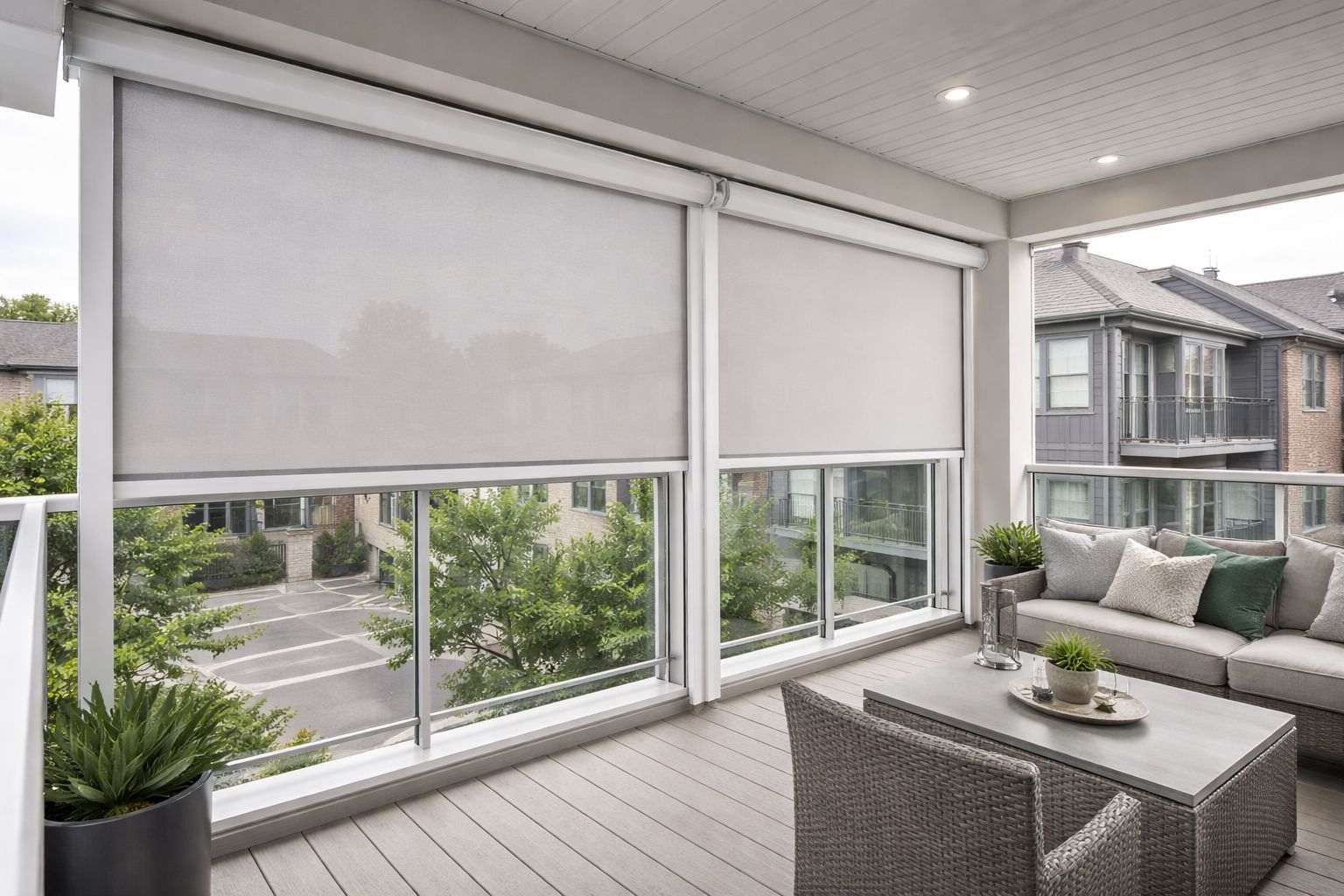
Where zip screens make the biggest difference
- Pergolas and covered outdoor rooms, where you want to close the sides completely and use the space in more weather.
- Elevated decks and balconies, where wind is stronger and a loose screen would flap.
- Covered porches, where sealed edges keep out bugs and rain blown in from the side.
- Patios that face a neighbour, where privacy has to reach right to the edge of the opening.
- Restaurant and outdoor seating areas, where screens go up and down every day and need to stay tidy.
Choosing the fabric for your zip screen
The track decides how the screen holds; the fabric decides what it does. TuffScreen is an open insect mesh for a bug-free seating area. SunTex 90 and SunTex 95 cut sun and glare and give daytime privacy while keeping the view out. SheerWeave 4800 gives more privacy, Soltis Proof 502 blocks the view completely, and PanoramaFR clear vinyl blocks wind and rain while keeping the view. Compare them side by side on the privacy screen products page, or read how much wind each fabric blocks.